

 By
By If I were starting a business today, I wouldn’t just ask, “What can I sell?”
I’d ask a more useful question:
“What problem do businesses face repeatedly, and how can I help them solve it every month?”
Think about a small office that needs its computers maintained, a café that runs out of packaging supplies, or a company that hires new employees every month and needs welcome kits. These businesses don’t necessarily need a supplier just once. They may need someone reliable who can help them again and again.
That is what makes the B2B business model interesting to me.
Instead of selling to individual customers, a B2B business sells products or services to other businesses. And when the service solves an ongoing problem, there may be an opportunity to build recurring revenue through monthly contracts, repeat orders, or maintenance agreements.
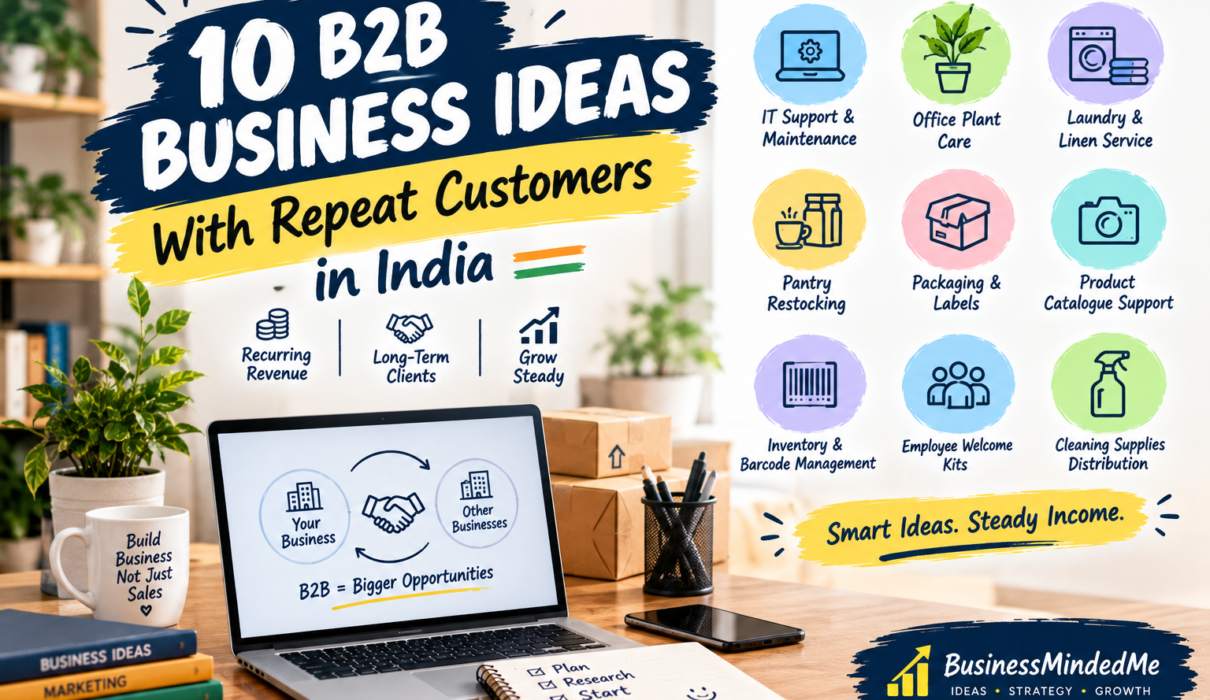
In this guide, I’ll explore 10 B2B business ideas with repeat customers in India, including their approximate starting investment, potential customers, how they can generate repeat orders, and useful resources to explore before starting.
Note: The investment, expense, revenue, and profit figures in this article are illustrative planning estimates, not verified industry averages or guaranteed results. Actual costs depend on your city, equipment, pricing, skills, and ability to acquire customers.
What Is a B2B Business?
A B2B, or business-to-business, business sells products or services to other businesses instead of selling directly to individual consumers.
For example:
- A company that supplies packaging materials to bakeries.
- A service provider that maintains computers for small offices.
- A supplier that delivers cleaning materials to hotels.
- A business that prepares employee welcome kits for companies.
The important difference is that your customer is another business, and you need to understand how your product or service helps that business operate better.
Why I Would Focus on B2B Businesses With Repeat Customers
I like the idea of repeat customers because it gives a business the opportunity to build relationships rather than constantly search for new buyers.
Here are three reasons I would consider this model.
1. I Can Build More Predictable Revenue
Suppose five small businesses pay me ₹8,000 per month for a service. That creates ₹40,000 in monthly revenue before expenses.
I would still need to maintain service quality and renew those contracts, but I wouldn’t have to start every month with zero confirmed business.
2. I Can Understand Customers Better Over Time
When I work with the same businesses regularly, I learn their schedules, preferences, recurring problems, and budgets. That makes it easier to improve the service and potentially offer additional solutions.
3. I Can Start With a Small Customer Base
I don’t necessarily need hundreds of customers. Depending on the business model, a small number of reliable clients may be enough to test the idea and build a sustainable operation.
However, I would never assume that repeat business happens automatically. Customers can leave if the service is unreliable, too expensive, or no longer useful.
10 B2B Business Ideas With Repeat Customers
Here is a quick overview before we look at each idea in detail.
| Business idea | Approx. starting investment | Potential repeat model |
|---|---|---|
| 1. Office plant maintenance | ₹15,000–₹40,000 | Weekly or monthly visits |
| 2. Computer and IT maintenance | ₹20,000–₹60,000 | Annual maintenance contracts |
| 3. Commercial laundry and linen service | ₹30,000–₹1 lakh | Weekly pickups and deliveries |
| 4. Office pantry restocking | ₹20,000–₹60,000 | Weekly or monthly supplies |
| 5. Product catalogue maintenance | ₹5,000–₹20,000 | Monthly service retainers |
| 6. Inventory and barcode management support | ₹10,000–₹35,000 | Monthly or quarterly audits |
| 7. Employee welcome kits and onboarding supplies | ₹15,000–₹40,000 | Repeat orders as employees join |
| 8. Commercial cleaning supplies distribution | ₹25,000–₹75,000 | Regular replenishment orders |
| 9. Printer and office equipment maintenance | ₹20,000–₹60,000 | Service contracts and consumables |
| 10. E-waste collection coordination | ₹15,000–₹50,000 | Scheduled collection agreements |
These are ten models I would investigate rather than assume are profitable. Some are service-based, while others require equipment, stock, transport, or specialist partners.
1. Office Plant Maintenance Service
What is it?
This business involves maintaining indoor plants for offices, clinics, cafés, hotels, coworking spaces, and commercial buildings.
Instead of simply selling plants, I would offer a complete maintenance service that includes watering, pruning, cleaning leaves, checking plant health, replacing damaged plants, and recommending suitable plants for indoor spaces.
Why I like this idea
Many businesses want their premises to look welcoming, but they may not have an employee who knows how to maintain plants properly.
I would offer a monthly package rather than charge only for the initial installation.
For example, a client could pay for a fixed number of visits each month, with replacement plants charged separately when needed.
Starting investment: ₹15,000–₹40,000
Monthly expenses: ₹5,000–₹15,000
Illustrative monthly revenue: ₹25,000–₹60,000
Illustrative monthly profit: ₹10,000–₹30,000
These figures assume a small operation with several paying clients and exclude any major expansion costs.
Potential customers
- Corporate offices
- Cafés and restaurants
- Clinics and salons
- Hotels and coworking spaces
- Property managers
How I would get my first customers
I would visit nearby offices and cafés with a simple proposal showing the difference between a one-time plant installation and a monthly maintenance plan.
I would also partner with local nurseries. The nursery could supply plants while I handle the ongoing maintenance.
Useful resource: IndiaMART to research plant suppliers, pots, planters, and gardening equipment.
Biggest challenge: Travel time and servicing multiple locations efficiently. I would group customers by area instead of accepting scattered bookings across an entire city.
2. Computer and IT Maintenance for Small Businesses
What is it?
This business provides routine computer maintenance and basic IT support to small offices that don’t have an in-house IT employee.
Services might include software updates, device setup, printer connectivity, troubleshooting, network checks, backup assistance, and coordinating repairs.
I would start with services I am qualified to provide and partner with experienced technicians for advanced repairs or network work.
Why I like this idea
A small business may have five, ten, or twenty computers. When one stops working, employees lose time and the business may lose money.
Instead of waiting for something to break, the business could pay for scheduled maintenance and access to support.
Starting investment: ₹20,000–₹60,000
Monthly expenses: ₹5,000–₹15,000
Illustrative monthly revenue: ₹30,000–₹80,000
Illustrative monthly profit: ₹12,000–₹35,000
Potential customers
- Small offices
- Coaching institutes
- Clinics
- Accounting firms
- Retail stores
- Small warehouses
How I would earn repeatedly
I would offer a monthly support plan with clearly defined limits, such as scheduled maintenance visits and a specified number of support requests. Hardware, replacement parts, and major repairs would be charged separately.
Useful resources: Zoho Desk for exploring help-desk software, and IndiaMART for researching IT equipment suppliers.
Biggest challenge: Customers expect fast solutions when their systems stop working. I would define response times and service limits in writing before accepting a contract.
3. Commercial Laundry and Linen Service
What is it?
A commercial laundry business collects, washes, dries, folds, and delivers linen or uniforms for businesses.
Depending on the equipment and customers, it could serve salons, gyms, clinics, hostels, restaurants, guesthouses, and small hotels.
Why I like this idea
Businesses that use towels, uniforms, bedsheets, or other washable textiles may need regular service throughout the month.
That creates an opportunity to agree on a recurring pickup schedule rather than depend on occasional individual orders.
Starting investment: ₹30,000–₹1 lakh for a small collection and coordination model that outsources washing. An in-house laundry setup may cost substantially more.
Monthly expenses: ₹10,000–₹30,000
Illustrative monthly revenue: ₹40,000–₹1 lakh
Illustrative monthly profit: ₹10,000–₹30,000
Potential customers
- Gyms and fitness studios
- Salons and spas
- Hostels and guesthouses
- Restaurants
- Small hotels
How I would start
Rather than immediately buying industrial washing machines, I would first find a reliable laundry partner and test demand with a few businesses.
My role could initially focus on customer acquisition, scheduled collection, quality checks, and delivery coordination.
Useful resource: IndiaMART to research commercial laundry equipment, linen suppliers, and potential service partners.
Biggest challenge: Consistent quality, hygiene, delivery timing, and handling lost or damaged items. I would establish clear procedures with the laundry partner before accepting recurring orders.
4. Office Pantry Restocking Service
What is it?
I would supply recurring office essentials such as tea, coffee, sugar, tissues, paper cups, drinking-water accessories, and other agreed pantry items.
Instead of selling a single carton to a business, I would help the business keep its pantry stocked through scheduled deliveries.
Why I like this idea
Small offices often have someone responsible for ordering supplies, but that person may already have other responsibilities. A reliable supplier who tracks regular requirements can save the office time.
The business doesn’t need to manufacture products. It can start by sourcing products from distributors and delivering them according to each client’s needs.
Starting investment: ₹20,000–₹60,000
Monthly expenses: ₹8,000–₹25,000
Illustrative monthly revenue: ₹40,000–₹1 lakh
Illustrative monthly profit: ₹8,000–₹25,000
Potential customers
- Offices with 10–100 employees
- Coworking spaces
- Coaching centres
- Clinics
- Small corporate branches
How I would earn repeatedly
I would offer weekly or monthly replenishment plans based on actual consumption. Customers could approve a standard list and budget, while extra items would require approval.
Useful resource: IndiaMART to research bulk pantry supplies and local distributors.
Biggest challenge: Margins can be thin, especially if delivery costs are high. I would focus on a compact service area, minimum order values, and reliable suppliers instead of trying to compete only on price.
5. Product Catalogue Maintenance for Online Sellers
What is it?
Many businesses sell through their own websites or online marketplaces. Their product information needs regular updates when prices, stock, images, descriptions, variants, or product specifications change.
I would provide a product catalogue maintenance service that keeps this information accurate and organised.
The service could include:
- Uploading new products
- Updating prices and stock information
- Organising product categories
- Checking product images and descriptions
- Maintaining spreadsheets
- Preparing simple product reports
This is different from building an entire website or running a full digital marketing agency.
Why I like this idea
A seller with hundreds of products may not want to hire a full-time employee just to maintain listings. A monthly service can provide ongoing support at a manageable scale.
Starting investment: ₹5,000–₹20,000
Monthly expenses: ₹2,000–₹8,000
Illustrative monthly revenue: ₹20,000–₹60,000
Illustrative monthly profit: ₹12,000–₹40,000
Potential customers
- Small online retailers
- Manufacturers with product catalogues
- B2B distributors
- Furniture and home décor sellers
- Businesses with their own ecommerce stores
How I would get customers
I would prepare a sample catalogue audit showing issues such as inconsistent product names, missing information, duplicate entries, and outdated prices.
Then I would offer a paid cleanup project followed by a monthly maintenance plan.
Useful resources: Shopify for understanding online store operations and Zoho Inventory for exploring inventory workflows.
Biggest challenge: Accuracy. I would create an approval process for price and stock changes rather than update commercially important information without confirmation.
6. Inventory and Barcode Management Support
What is it?
This business helps small retailers, distributors, and warehouses organise their stock records.
Services could include counting inventory, reconciling physical stock with spreadsheets or software, preparing barcode labels, organising product codes, and creating simple stock reports.
I would not begin by building complicated inventory software. I would start by helping businesses use existing tools properly.
Why I like this idea
A business can lose time and money when its records don’t match the stock physically available. A periodic inventory check can help identify discrepancies and improve purchasing decisions.
Starting investment: ₹10,000–₹35,000
Monthly expenses: ₹3,000–₹10,000
Illustrative monthly revenue: ₹25,000–₹70,000
Illustrative monthly profit: ₹12,000–₹35,000
Potential customers
- Small wholesalers
- Spare-parts dealers
- Retail stores
- Small warehouses
- Distributors with many product variants
How I would create repeat business
I would offer an initial stock audit, followed by monthly or quarterly checks. Customers with frequent stock movements might need more regular support.
Useful resources: Zoho Inventory to explore inventory management software and IndiaMART to research barcode scanners and label printers.
Biggest challenge: Trust and accuracy. I would document the counting process and clearly distinguish between stock discrepancies found and any conclusions about their cause.
7. Employee Welcome Kits and Onboarding Supplies
What is it?
When a company hires someone new, it may provide a welcome kit containing items such as notebooks, pens, bottles, ID-card holders, folders, T-shirts, or other branded merchandise.
I would help businesses source, customise, package, and deliver these items.
The difference from a typical gift business is that I would focus on ongoing employee onboarding and corporate requirements, not only festivals or one-time events.
Why I like this idea
Companies that hire regularly may need welcome kits throughout the year. They may also reorder supplies when they open a new office, run an employee event, or refresh their branding.
Starting investment: ₹15,000–₹40,000
Monthly expenses: ₹5,000–₹15,000
Illustrative monthly revenue: ₹30,000–₹80,000
Illustrative monthly profit: ₹8,000–₹25,000
Potential customers
- Growing startups
- IT and professional-services companies
- Recruitment agencies
- Coworking spaces
- Training institutes
How I would start
I would create three sample packages at different price points and outsource printing and customisation initially. I would avoid purchasing large quantities until I understood which products clients actually order.
Useful resource: IndiaMART to research corporate gifts, branded merchandise, packaging, and printing vendors.
Biggest challenge: Orders can be irregular, and customised stock may be difficult to resell. I would request a deposit before placing supplier orders and confirm quantities, artwork, and delivery dates in writing.
8. Commercial Cleaning Supplies Distribution
What is it?
This business supplies recurring cleaning essentials to offices, gyms, restaurants, clinics, and other commercial premises.
Products could include floor cleaners, surface cleaners, garbage bags, microfiber cloths, mops, dispensers, gloves, and paper products.
I would focus on supplying the products businesses use regularly rather than trying to manufacture cleaning chemicals myself.
Why I like this idea
Cleaning supplies are consumables. Once a business finds a reliable supplier with suitable pricing and quality, it may reorder the same products regularly.
Starting investment: ₹25,000–₹75,000
Monthly expenses: ₹8,000–₹25,000
Illustrative monthly revenue: ₹40,000–₹1 lakh
Illustrative monthly profit: ₹8,000–₹25,000
Potential customers
- Small offices
- Restaurants and cafés
- Gyms
- Schools and coaching centres
- Property maintenance companies
How I would get customers
I would prepare a simple product list with pack sizes, prices, and reorder options. I would approach businesses in one local area and offer scheduled deliveries based on their consumption.
Useful resource: IndiaMART to research bulk cleaning products, dispensers, and commercial suppliers.
Biggest challenge: Price competition and product quality. I would compare suppliers carefully and avoid stocking too many slow-moving products.
9. Printer and Office Equipment Maintenance
What is it?
This business focuses on keeping printers and selected office equipment operational through preventive maintenance, troubleshooting, servicing, and consumable replacement.
I would initially partner with an experienced technician rather than try to repair equipment without the required skills.
Why I like this idea
Businesses that print invoices, reports, labels, forms, or educational materials may rely on their printers every day. They may prefer having a reliable service contact rather than searching for a technician every time something goes wrong.
Starting investment: ₹20,000–₹60,000
Monthly expenses: ₹5,000–₹15,000
Illustrative monthly revenue: ₹30,000–₹80,000
Illustrative monthly profit: ₹10,000–₹30,000
Potential customers
- Schools and coaching institutes
- Accounting offices
- Clinics
- Retailers
- Small warehouses
How I would earn repeatedly
I would offer scheduled maintenance and priority support under an annual or monthly agreement. Toner, spare parts, and major repairs would be quoted separately where appropriate.
Useful resource: IndiaMART to research printer parts, consumables, and service equipment.
Biggest challenge: Different printer models require different expertise and parts. I would begin with a limited range of equipment and expand only when I had dependable technical support.
10. E-Waste Collection Coordination for Businesses
What is it?
Businesses eventually need to dispose of old computers, monitors, printers, cables, and other electronic equipment.
I would explore a service that coordinates scheduled collections and connects businesses with appropriately authorised e-waste recyclers or refurbishers.
The business would focus on collection scheduling, documentation, communication, and reliable handover rather than operating a recycling plant.
Why I find this idea interesting
Companies may replace equipment periodically, relocate offices, or clear out unused electronics. A professional collection service could make the process more organised.
Starting investment: ₹15,000–₹50,000 for a small coordination model, depending on transport and storage arrangements.
Monthly expenses: ₹5,000–₹20,000
Illustrative monthly revenue: ₹20,000–₹60,000
Illustrative monthly profit: ₹8,000–₹25,000
These figures are especially dependent on the collection volume, transport arrangements, and the commercial agreement with recycling partners.
Potential customers
- Small and medium-sized offices
- Schools and colleges
- IT companies
- Coworking spaces
- Businesses replacing computer equipment
How I would start
I would first identify registered recyclers and understand their collection requirements. Then I would approach local businesses with a scheduled collection proposal.
I would not claim to be an authorised recycler unless I had the necessary registrations and approvals.
Useful resources:
- CPCB E-Waste Management Portal to understand the regulatory framework and find relevant official information.
- Maharashtra Pollution Control Board for state-level e-waste information.
Biggest challenge: Compliance, safe handling, transportation, and proper documentation. I would confirm the applicable requirements and work with authorised partners before accepting collections.
Which B2B Business Would I Choose?
If I were comparing these ideas, I would look at my available capital, skills, and ability to find customers before choosing one.
| If I wanted… | I would explore… |
|---|---|
| A low-investment service business | Product catalogue maintenance |
| A local, relationship-driven business | Office plant maintenance |
| A business with regular consumable orders | Pantry restocking or cleaning supplies |
| A technical service business | Computer and IT maintenance |
| A business serving growing companies | Employee welcome kits |
| A specialised operational service | Inventory and barcode support |
| A business with a sustainability angle | E-waste collection coordination |
There is no universal winner here. A business that works well in a city with many offices might be difficult to operate in an area with few commercial customers.
I would validate local demand before investing heavily.
How I Would Get My First 5 B2B Customers
I wouldn’t begin by spending a large amount on advertising. I would first test whether businesses actually want the service.
Step 1: Choose One Specific Customer Type
Instead of targeting every business, I would select one group.
For example, if I chose office pantry restocking, I would focus on small offices in one business district.
Step 2: Speak to 20 Potential Customers
I would contact business owners, office managers, or operations managers and ask questions such as:
- How do you currently handle this problem?
- How often do you need the service or product?
- What is frustrating about your current supplier?
- Would a scheduled monthly service be useful?
- What would you need to see before switching suppliers?
I would listen for repeated problems rather than assume my idea is useful.
Step 3: Create a Simple Offer
I would prepare a one-page proposal describing the service, price, what is included, what costs extra, and how customers can get started.
For a service business, I would consider a paid pilot before asking for a long-term contract.
Step 4: Use Direct Outreach
I would use a combination of:
- Google Maps to identify relevant local businesses
- LinkedIn to find business owners and operations managers
- Email and telephone outreach
- Local business networking groups
- Referrals from suppliers and existing contacts
My first objective would be to secure a small number of paying customers, not collect hundreds of social media followers.
Step 5: Turn a Successful Trial Into a Recurring Agreement
After delivering the first order or service, I would ask the customer whether they want a regular schedule.
I would put the frequency, service limits, pricing, payment terms, and cancellation conditions in writing.
How Much Can a Small B2B Business Earn?
Let’s use a simple example rather than assume every business will earn a particular amount.
Suppose I provide a monthly service to eight businesses, each paying ₹7,500.
| Calculation | Amount |
|---|---|
| 8 customers × ₹7,500 | ₹60,000 monthly revenue |
| Example monthly operating expenses | ₹25,000 |
| Amount left before tax and other excluded costs | ₹35,000 |
This is an illustration, not a forecast. The result could be much lower if customer acquisition is expensive, service delivery takes longer than expected, payments are delayed, or customers leave.
For product-based businesses, I would also account for stock costs, delivery, damaged goods, and the time spent managing orders.
The important number is not just monthly sales. It is what remains after delivering the service and keeping the business running.
Mistakes I Would Avoid When Starting a B2B Business
1. Buying Equipment Before Finding Customers
I would try to secure a paid pilot or a few confirmed orders before spending heavily on machinery, inventory, or vehicles.
2. Offering Too Many Services
A broad offer can make it difficult to explain why a customer should choose me. I would start with one clearly defined problem and expand later.
3. Competing Only on Price
If my only advantage is being cheaper, another supplier can easily undercut me. I would focus on reliability, clear communication, convenience, and consistent quality.
4. Ignoring Payment Terms
B2B customers may request credit periods. I would set clear payment terms, track outstanding invoices, and avoid allowing a few late-paying customers to create a cash-flow problem.
5. Assuming Every Customer Will Stay
Repeat business depends on continued value. I would regularly check service quality, respond to complaints, and make sure customers know exactly what they are paying for.
Final Thoughts: Build a Business That Customers Need Again
If I were starting a B2B business in India, I would look beyond the obvious ideas and search for everyday problems that businesses face repeatedly.
Office maintenance, catalogue updates, inventory support, pantry supplies, and equipment servicing may not sound glamorous. But the right niche can offer a clear customer need and an opportunity to build long-term relationships.
I would start with one customer type, validate the demand, win a few paying clients, and improve the service before expanding.
Because ultimately, a repeat customer is not created by a clever business idea alone. It is earned by solving a problem reliably, at a price that makes sense for both sides.
Frequently Asked Questions
1. What are the best B2B business ideas with repeat customers?
Ideas worth exploring include IT maintenance, office pantry restocking, commercial cleaning supplies, product catalogue maintenance, inventory support, laundry services, and office plant maintenance. The best option depends on local demand, your skills, startup budget, and competition.
2. Which B2B business can I start with low investment in India?
Service-based options such as product catalogue maintenance, basic inventory support, or office plant maintenance may be possible with a relatively small setup. Costs depend on equipment, travel, software, and whether you already have the necessary skills.
3. How do B2B businesses get repeat customers?
They solve an ongoing problem, deliver consistently, communicate clearly, and offer a useful recurring service or convenient reorder process. Monthly agreements and scheduled deliveries can help, but customers are not guaranteed to renew.
4. Are B2B businesses more profitable than B2C businesses?
Not necessarily. B2B businesses may have larger orders or longer-term agreements, but they can also face longer sales cycles, delayed payments, customised requirements, and customer concentration risk. Profitability depends on the individual business model.
5. How can I find B2B customers in India?
Start by choosing a specific customer group and building a list of relevant businesses. You can use Google Maps, LinkedIn, local business networks, industry directories, referrals, and direct outreach to test demand.
6. Should I offer monthly contracts or charge per order?
I would choose based on the service. Maintenance and ongoing support may suit monthly contracts, while pantry supplies, packaging, and onboarding kits may work better through repeat purchase orders. In either case, the pricing and scope should be clear.
SEO Settings for WordPress
SEO title: 10 B2B Business Ideas With Repeat Customers in India
Focus keyword: B2B business ideas with repeat customers
Suggested URL slug: b2b-business-ideas-repeat-customers
Meta description: Explore 10 B2B business ideas with repeat customers in India, including startup costs, potential clients, recurring revenue models, and practical tips.
Suggested category: Business Ideas
Suggested tags: B2B Business Ideas, Business Ideas India, Recurring Revenue, Small Business Ideas, Low Investment Business, B2B Services, Entrepreneurship